MemoriedOro
Proclamation of the Republic of Venice 1784 - Inquisitor of the Arts - Andrea Tron
Proclamation of the Republic of Venice 1784 - Inquisitor of the Arts - Andrea Tron
Couldn't load pickup availability
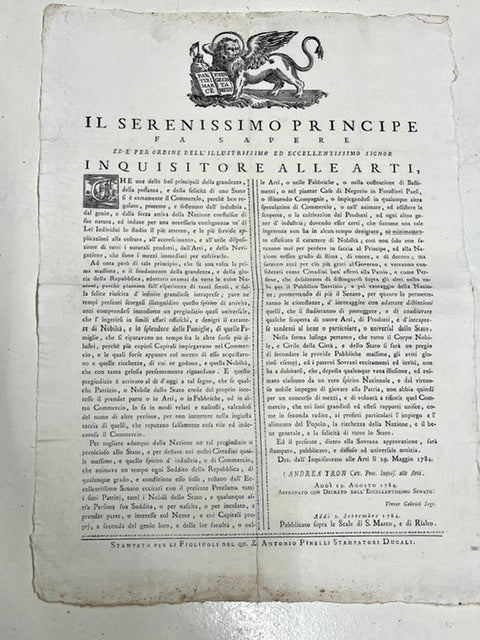
Rare and important original proclamation/decree of the Republic of Venice printed in 1784.
The act bears at the head the splendid and clear engraving of the winged Lion of Saint Mark with the open book "Pax Tibi Marce Evangelista Meus".
The document, entitled "The Most Serene Prince makes known and it is by order of the Most Illustrious and Most Excellent Lord Inquisitor of the Trades...", deals with the incentivization of commerce, industry, and the trades practiced by the Venetian nobility for the economic recovery of the State.
Historical characteristics:
-
Date: May 29, 1784 - published at Rialto and Saint Mark on September 2, 1784 -
- Signatory: Andrea Tron, Knight and Procurator, Inquisitor of the Trades
- Printer: Antonio Pinelli, Ducal Printers
- Condition: Very good, strong vintage paper well-preserved with original editorial folds.
- Dimensions: approx. 36 x 50 cm
This proclamation is a measure of great historical-economic value.
The promoter of the act is Andrea Tron (1712–1785), one of the most influential figures in eighteenth-century Venetian politics, nicknamed by his contemporaries "El Paròn" ("The Master") due to his enormous authority and his constant activity as a reformer of the institutions and economy of the Serenissima.
Here he signs in his capacity as Inquisitor of the Trades, the magistracy responsible for the oversight, regulation, and relaunch of the craft guilds and the textile/manufacturing industry.
The proclamation addresses one of the most serious structural problems of the Venetian economic decline of the eighteenth century: the nobility's prejudice against commerce and industry.
The text opens by stating that the greatness, power, and happiness of a State are based on well-regulated commerce, industry, and navigation—essential tools for cultivating the products of the land and providing employment for the population.
Tron openly denounces how, over the decades, an "almost universal prejudice" has spread: the Venetian patricians and nobles have begun to consider commercial or manufacturing activities as a "vile and indecorous" occupation, fearing to stain their rank or their reputation of nobility if they were directly involved in business.
For this reason, nobles who wanted to invest in commerce or factories were forced to do so veiledly, secretly, or through fronts.
To push the ruling class to reinvest their capital into the real economy, the proclamation establishes fundamental principles:
* Dignity of enterprise: Engagement in commerce, the opening of factories, the construction of ships, or the founding of companies does not in any way diminish the title of Nobility, the honor, or the decorum of the family.
* Economic patriotism: Investing one's wealth in industry and the arts is declared an act of virtue and patriotism, a public service to provide work for the people and wealth for the State.
* Incentives and recognition: Those who distinguish themselves in the promotion of new discoveries, the development of new products, or the creation of manufactures and commercial traffic will receive the benevolence, protection, and direct esteem of the Government and the Venetian Senate.
This proclamation is considered a sort of "political and economic testament" of Andrea Tron—who would die the following year, in 1785—and represents a desperate and enlightened attempt by the Serenissima to modernize its economy before the fall of the Republic in 1797.
Condividi