MemoriedOro
Lot of 19th-century advertising trade cards - Apollo Wien - Nations and Costumes of the World - Sammelbilder
Lot of 19th-century advertising trade cards - Apollo Wien - Nations and Costumes of the World - Sammelbilder
Couldn't load pickup availability
Lot of 37 Historical Apollo Wien Trading Cards
1890-1910
Nations and Costumes of the World
Rare Advertising Chromolithographs, with Franck and Hartwig variants
Lot of 37 original historical advertising cards (Sammelbilder) dating back to the turn of the 19th and 20th centuries (approx. 1890-1910).
The cards feature a beautiful and elegant graphic design on the front in bright color chromolithography, dedicated to the countries of the world, their national flags, and their traditional costumes, complete with official coats of arms.
They are from the Austrian factory "Apollo-Kerzen- u. Seifen-Fabriken, Wien" (Apollo Candle and Soap Factory of Vienna).
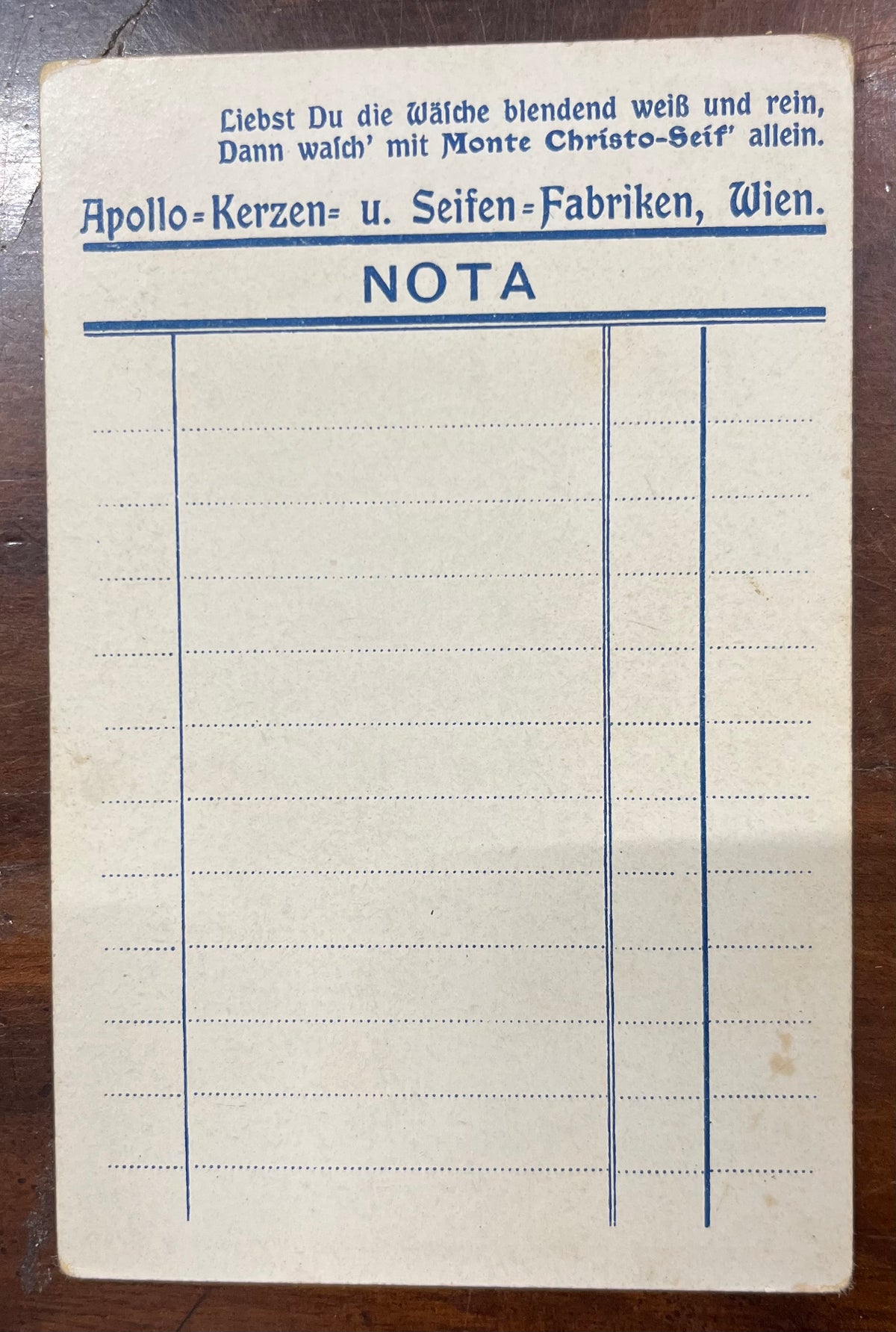
They were distributed not only as collectibles but also as practical shopping lists or account notebooks.
Some cards feature linked advertisements on the back from other famous Central European companies of the time:
• Hartwig & Vogel (the famous cocoa, chocolate, and marzipan factory in Dresden, Bodenbach, and Vienna), promoting their Diana-Canditen candies
• Heinrich Franck Söhne of Linz, a well-known company that produced coffee substitutes and chicory
The country names are in the original language (German/French).
The cards are in excellent condition, not glued, with clean and highly legible backs.
The lot is composed as follows:
• 34 Cards with "Apollo-Kerzen- u. Seifen-Fabriken, Wien" back:
They feature the classic back structured as a notepad (Note) with an advertisement for Monte Christo soap.
• 2 Cards with "Caffè Franck" back (Rare Variant):
They feature on the back a curious and exceptional "Warning!" entirely in Italian intended for the Adriatic/Julian market of the Austro-Hungarian Empire, warning customers against imitations (corresponds to Morocco and New South Wales).
• 1 Card with "Hartwig & Vogel" back (Rare Variant):
It features the German advertisement of the Dresden and Vienna chocolate factory for "Diana-Canditen" candies (corresponds to Norway).
Complete list of the 37 pieces included in the lot:
1. Vereinigte Staaten von Nordamerika
2. Schweiz
3. Kochinchina
4. Tonga
5. Dalmatien
6. Japan
7. Bolivia
8. Montenegro
9. Mexico
10. Belgique
11. Marokko
12. Türkei
13. Kolumbien
14. Persien
15. Deutschland
16. Russland
17. Venezuela
18. San Domingo
19. Birma
20. Niederlande
21. Monaco
22. Kanada
23. Aegypten
24. Frankreich
25. Schottland
26. Siam
27. Bulgarien
28. Chile
29. Dänemark
30. Norwegen
31. Grossbritannien (England)
32. Samoa
33. Neuseeland
34. San Salvador
35. Kongo-Staat
36. Spanien
37. Nouvelle Galles du Sud
Some trivia
* The flags and geographical names printed on the cards capture the geopolitical map between 1890 and 1905.
The lot includes territories that no longer exist today under those names or political arrangements:
• Kongo-Staat (Congo Free State): Represented with the blue flag and yellow star. It was the infamous personal possession of King Leopold II of Belgium before becoming a state colony in 1908.
• Kochinchina (Cochinchina): Ancient name for the southern region of Vietnam, at the time part of French Indochina
• Dalmatien (Dalmatia): Today part of Croatia, at the time it was a kingdom incorporated directly into the Austro-Hungarian Empire
• Nouvelle Galles du Sud (New South Wales): An Australian state which has a dedicated card here with a British colonial flag dating back to before the independence and federation of Australia (which occurred in 1901)
2. These cards are the ancestors of modern discount coupons and cross-promotional gadgets.
The Apollo company produced basic necessities (soap and candles) and collaborated with candy brands (Hartwig & Vogel) or coffee substitutes (Franck).
Sharing advertising space on the back or inserting the cards into packaging of different products allowed companies to halve printing costs and reach more families simultaneously.
3. Unlike classic Liebig cards or chocolate cards that had recipes or educational explanations on the back, the Apollo factory’s choice to print a grid for accounting ("NOTE") was a brilliant loyalty-building move.
Housewives of the time were encouraged to keep the card in their shopping bag to use as a reminder for the grocer, keeping the Apollo soap logo constantly before their eyes.
4. The bright colors and golden hues you see are the result of chromolithography, an extremely complex 19th-century printing technique. To create just one of these cards, the sheet had to pass under a stone press up to 10 or 12 times, once for each color. The use of embossed gold (visible on the frames and coats of arms) served to give the cards a luxurious appearance, transforming simple advertising scraps into small art objects to be collected in bourgeois salons.
Condividi